Your Patient Has a Clitoral Inclusion Cyst. You've Never Seen One Before. What Do You Do?
The Uncertain Lesion: When Your Colleague Calls for Advice
The referral comes in from a colleague. “Unusual vulvar lesion, uncertain diagnosis, please advise.”You examine her. It’s periclitoral, non-tender, mobile, cystic on palpation.You’ve read about clitoral inclusion cysts. You’ve never managed one. And the patient is sitting there waiting for your answer.
1
Rare and Unforgiving: The Trap of Misdiagnosing Periclitoral Masses
Clitoral inclusion cysts are rare — which is exactly why most gynecologists encounter them unprepared.They are most commonly a consequence of previous circumcision or clitoral hood reduction, though they can occur spontaneously. They are frequently misdiagnosed as Skene’s duct cysts, periurethral cysts, or sebaceous cysts — each of which requires a different approach.The wrong approach on periclitoral tissue is not a minor error. The anatomy does not forgive imprecision.
2
Protecting the Nerve: Precision Excision for Rare Inclusion Cysts
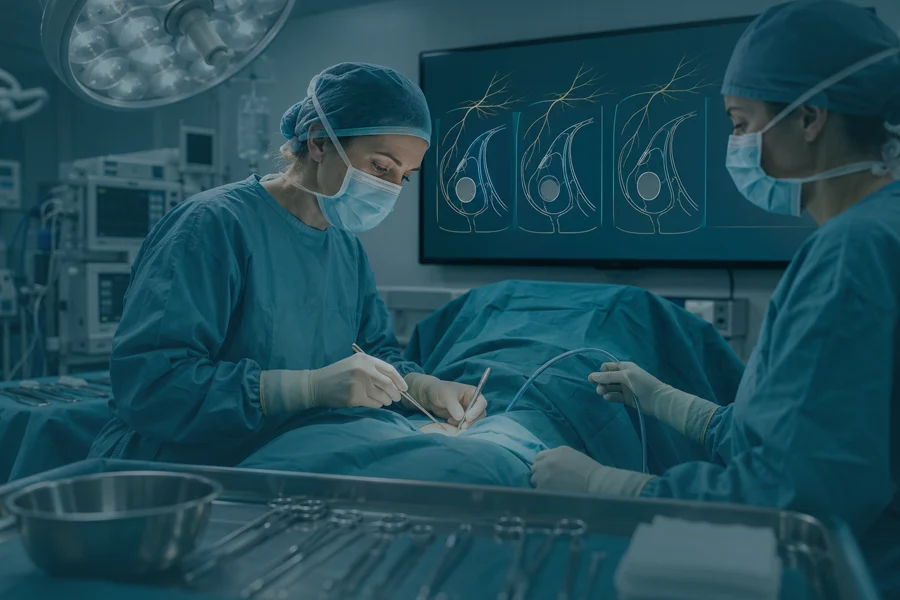
The differential diagnosis hinges on location and origin: clitoral inclusion cysts sit deep to the clitoral hood, are non-tender unless infected, and transilluminate. Skene’s duct cysts are paraurethral and often present with dyspareunia.Surgical excision is definitive — but the key principle is identifying the cyst plane before entering it. The clitoral anatomy must be respected throughout: the dorsal nerve is immediately superior to the operating field.I present two full excision cases in Videos 12 and 17 — different anatomy, different complexity, same principles. Watching both gives you the pattern recognition you can’t get from a single case.
3
Clinical Expertise: Preparing Your Hands for the Unexpected Case
Rare cases define confident surgeons. Module 4 gives you two clitoral inclusion cyst excisions back to back — because the second case always teaches you what the first one couldn’t.Pattern recognition comes from repetition. Watch both.
Build pattern recognition for rare periclitoral excisions.